What I learned from the people I stopped chasing, and the ones I found in Diafani
Five weeks in the Alps and on three Greek islands, and the clearest thing I learned came from people who gave nothing for return, until I noticed I'd stopped doing the same.
The Field Notes stopped in July. I want to start with why, because the reason turned out to be the most useful thing that happened all summer.
The Field Notes stopped in July. I want to start with why, because the reason turned out to be the most useful thing that happened all summer.
They stopped because I had nothing to write that I wanted to write. The weeks I would have been reporting on were made mostly of waiting. Waiting for a decision from a partner. Waiting for a co-founder to reply. Waiting for other people’s timelines to become mine. A weekly rhythm that reports on waiting quietly makes waiting acceptable, and mine had.
Then two weeks in the Alps, and three across three Greek islands. I should say what those three weeks actually looked like, because “Greek islands” tends to conjure something I didn’t do. I am not a water person. I kept the sea to a minimum and spent the days the way I spend them anywhere, on my feet from early: climbing in Kalymnos, hiking and scrambling in Halki, then hiking in Karpathos and looking for crags nobody had written up yet, ending in Diafani, on the island’s north end, where I was also scouting routes for tours I want to run in 2027. Five weeks of moving, and of sleeping properly.
I didn’t go looking for clarity and I don’t think you can. What happened first was subtraction. Something I had been carrying without noticing stopped being there, and in its absence I could finally see its shape. It was the low constant hum of people and projects I was pulling along, none of which were pulling anything back.
I’ve since given the pattern names, because things you can’t name you keep agreeing to. There are people who take your energy and return none of it; the meetings are warm and nothing comes of them. There are people who take your work, the structures and documents and introductions, and never reciprocate with a decision or a commitment. There are projects nobody has killed, so they stay technically alive, costing a nudge here and a follow-up there, almost nothing per week and everything per year. And there is a subtler pair worth naming precisely: the “let’s you and him fight” move, where someone volunteers your energy into a battle that is theirs and then watches from the side to see how it goes, and armchair bravery, which is boldness about risks that land on a balance sheet other than the speaker’s own. I’ve had both aimed at me this year, more than once, by people whose company I otherwise enjoy.
What holds all of it together is chasing. And chasing is the part I have to own, because it’s mine.
Here is the arithmetic that changed my mind. The people I’ve been chasing are, almost without exception, people I respect. They’re capable and they’re decent and their lives are exactly as full as mine. That’s precisely the problem. When two full lives meet and only one of them generates the pull, the pull isn’t persistence. It’s a subsidy. I’d been paying it for a long time and calling it commitment.
But subtraction alone doesn’t teach you much. It clears space. What filled the space was the people I was with, and what I noticed in how they behaved.
It started in Kalymnos, on rock, no plan beyond the next day’s crag. What I’d forgotten is how quickly that life makes company: other climbers at the base of a route, locals who see you come back three days running and start greeting you by name. None of it negotiated; people simply made room. That’s how we found Emborios, up at the island’s north end, and in Emborios, Irina at the To Kyma taverna, who fed us and talked to us as though we’d been coming back for years. We hadn’t. We probably will now.
Halki was hiking and scrambling with the usual gang, who behaved well, which in our vocabulary means everyone carried their share and nobody needed managing. Miky did a fine scramble and then had a birthday in a wild place with no venue and nothing arranged into an occasion, and it was the best celebration of the summer, which is worth saying plainly, because it required nothing to be bought.
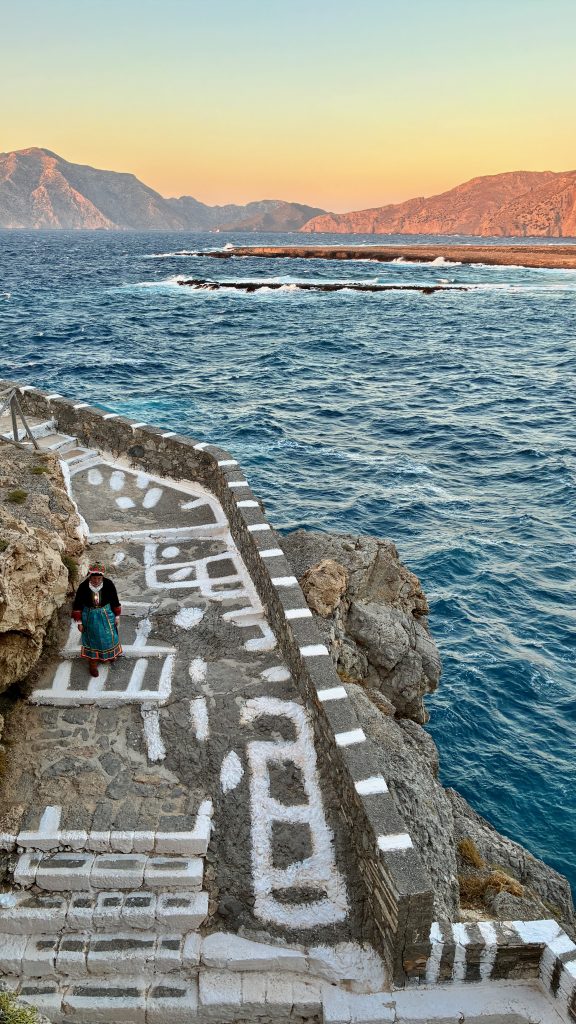
Then Karpathos on foot for days, half of it hunting crags nobody had bolted, ending in Diafani.
I should say first what I was, in that ancient village. At the Vroukounta festival, while they were singing, our group was shushed; rightly. I was an alien, disturbing a tradition that wasn’t mine, and being too loud about it. I was a guest and I didn’t always carry it well. I intend to do better next time. That’s a small lesson about belonging in its own right: it isn’t granted because you arrived with good intentions. It’s earned by paying attention to how a place already works before you add anything to it, and a song is exactly the kind of thing you go quiet for.
Once I’d understood that, I could actually see the place. Natalia spends weeks there alone, in something close to awe of the sea. I don’t share the sea, but I recognised what I was looking at: passion held so completely it stops being comfortable. Her values around love and attention are absolute in a way that costs her something, and watching that up close was clarifying and painful. It showed me a gap I hadn’t noticed I was carrying. I wasn’t myself anymore. I was dry and empty, and I’d been getting through the days without registering it. Not something Diafani gave me. Something it made visible. Leila, an architect, carries an elegance that isn’t performed; it’s in the articulation, in how a sentence is finished, nothing hurried, nothing wasted. Maria never stops: her generosity, her attention to detail, a welcome offered before you’ve worked out you needed it, and offered the next day again without any accounting. Captain Nikos. Captain Antonis and his crew. The people who came out to clean Tristomo. Everyone who made room at the Vroukounta festival. None of it performed. It was simply how the days were assembled; people putting their whole attention into small, unglamorous things, a boat, a meal, a path kept clear, a guest they had no obligation to look after, because they loved it and because the person in front of them mattered.
That contrast did the actual work. Set beside those weeks, the relationships I’d been subsidising looked less like a demanding season and more like a category error. I had been mistaking politeness for warmth, and interest for commitment. The people in Diafani gave neither politeness nor interest. They gave attention, immediately, to someone who could do nothing for them.
So the rule I’m taking into the autumn is simple enough to survive a busy November. I’ll make the ask once, clearly. I’ll follow up once. Then I stop. If a thing only moves when I push it, the thing doesn’t want to exist, and I’m the only one who hasn’t noticed.
The rest follows from that. Respect explains why a relationship stays cordial; it doesn’t explain why I should keep funding it. Ownership gets demonstrated by a decision, a signature, or a budget, never by presence in a room, and never by the two moves I named above. Both are cheap to produce and expensive to receive, and I’ve stopped pretending otherwise. Nothing gets to stay technically alive, either: every open thread gets a date on which it either becomes real or ends properly.
The part I’d been getting backwards for years is the one about ground. August didn’t work because it was time off. It worked because moving in mountains is the condition under which I think clearly, and because I was moving alongside people who are generous with their attention. I’d been treating both as the reward for the work rather than the ground the work stands on. They go in the calendar first now.
The Field Notes restart this week. Shorter, and with more attention paid to fewer people, which is more or less what Diafani was trying to tell me.
On my use of AI
The thinking here is mine; the pattern I name, the decision to stop chasing, what I noticed in Diafani and what it corrected in me. That came from five weeks of walking and sitting with it afterwards, not from a prompt.
English is my second language. I use AI the way I’d use a good editor: to hold the structure while I found the right order for these scenes, to tighten sentences, and to catch the errors a non-native writer often can’t see in his own draft. One useful correction came out of that process directly: an earlier pass buried the paragraph about being shushed in Diafani among the other portraits, and it reads better, and more honestly, moved up front so it frames everything that follows rather than sitting as one more anecdote. That’s a structural note, not a factual one, and I took it.
I drafted this with Claude, a model built by Anthropic. I mention that plainly, the way I do whenever AI touches something published under my name, whether or not the subject has anything to do with Anthropic. Nothing here was fact-checked against outside sources, because nothing here makes a claim beyond my own week. What you’re reading is what I saw and what I decided. If a sentence argues something, I’m the one arguing it.